

This page began with a passing remark by Hermione Hobhouse, that understanding Thomas Waller was a key to understanding Thomas Cubitt’s finances. It was also prompted by a conversation on site with a plumber, Barry Waller, who said that his family had taken over Thomas Cubitt’s business. That seemed far-fetched at the time, but the surviving records bear it out: Wallers did carry the building side of the business forward after Cubitt’s death. The page is dedicated to Barry Waller. The sales particulars for Cubitt Lodge were an early starting point. Additional genealogical research was carried out by Deborah Lister of DW Research & Archive Services.
Hobhouse, in Thomas Cubitt: Master Builder (1971), describes Thomas Waller as Cubitt’s “confidential clerk”, in charge of the financial side of the business from 1833 or earlier. By the end of Cubitt’s life he was largely responsible for the accounts, including the half-yearly interest paid to the many people who had lent Cubitt money, and Cubitt’s own investments. Hobhouse could not say how Thomas was related to John Waller, who witnessed Cubitt’s signature from 1830 and was more concerned with the building side. She notes that John and Robert Waller carried on that side after Cubitt’s death, and that Messrs R. & J. Waller were among the successful tenderers for the Grosvenor Gardens houses.
Which Waller?
Hobhouse wrote of the Wallers as if they might be one family. The records show at least three, sharing the same few forenames: John, James, Robert, Thomas, Edward and William. That is why they have so often been run together. Two of Cubitt’s most important men were Wallers, with different parents.
| Thomas Windus Waller (1802–1870) | John Waller (1789–1864) | |
|---|---|---|
| Role | Cubitt’s cashier, accountant and “confidential clerk” | Principal manager of Cubitt’s building operations |
| Family | Son of William Waller of Hoxton and Harriet King | Son of Charles Waller of Huntingdon and Elizabeth Rignell |
| With Cubitt | From the early 1830s at the latest; in 1828 he was Lord Carrington’s secretary | “Nearly forty years” by the time of his death |
| After 1855 | Receiver to the estate of George Cubitt | Took over the building business with his son Robert John, as Waller & Son of 4 Lyall Street |
| Died | October 1870, at Vauxhall station | 26 September 1864, at 5 Belgrave Road |
Thomas and John were not brothers, nor father and son. Whether they were more distantly related is not known: Thomas’s father William was baptised in Shoreditch in 1770, John’s father Charles in Huntingdon in 1769, and no link between those two men has yet been found. A third family, the Wallers of Woodcote, were baronets. Sir Thomas Wathen Waller married Catherine Wise, daughter of the Revd Henry Wise, in 1836. The Wises were Cubitt’s ground landlords on the Wise Estate in Pimlico, and in 1888 their Tothill Fields estate passed to George Henry Waller of Woodcote, making the Wallers of Woodcote ground landlords to the Cubitt estate.
Thomas Windus Waller
Thomas Windus Waller was baptised at St Botolph, Bishopsgate, in April 1802, the son of William Waller, a builder of Kingsland, and Harriet King. An earlier suggestion that he was the Thomas Waller recorded as a stonemason at 111 Shoreditch in 1810 is now set aside.
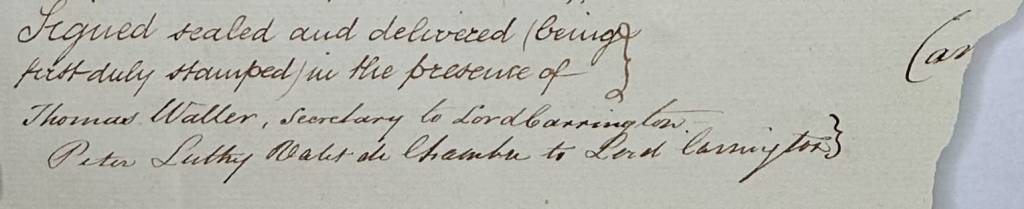
In December 1828 he was secretary to Lord Carrington, Robert Smith of the Smith banking family. In that capacity he witnessed a bond of indemnity between Carrington and Earl Stanhope. He would certainly have known Thomas Cubitt, and by the early 1830s at the latest he was working for him.
In 1831 he married Sarah Maria Shadbolt at Edmonton, signing himself “Thomas Windus Waller”. His brother William witnessed the marriage. When their son Henry was baptised at St Margaret’s, Westminster, in 1848, Thomas was described as a builder’s clerk, of 4 Bessborough Street, Pimlico.
Thomas Cubitt’s will
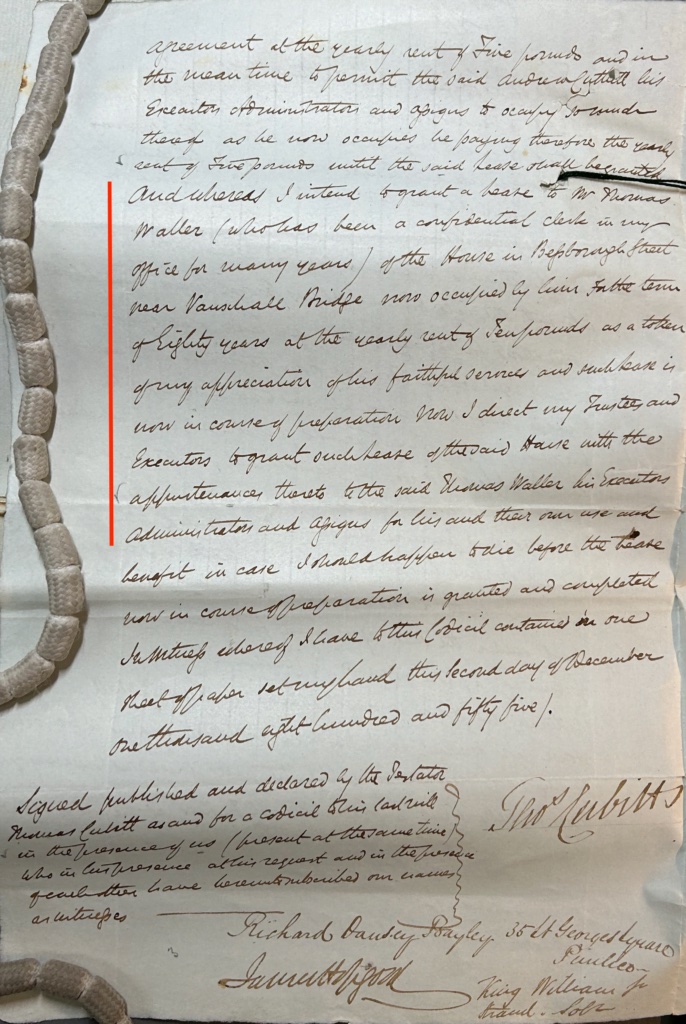
Thomas Cubitt died in December 1855, leaving a very long will, drafted by James Hopgood. A PDF of the full manuscript will is available here.
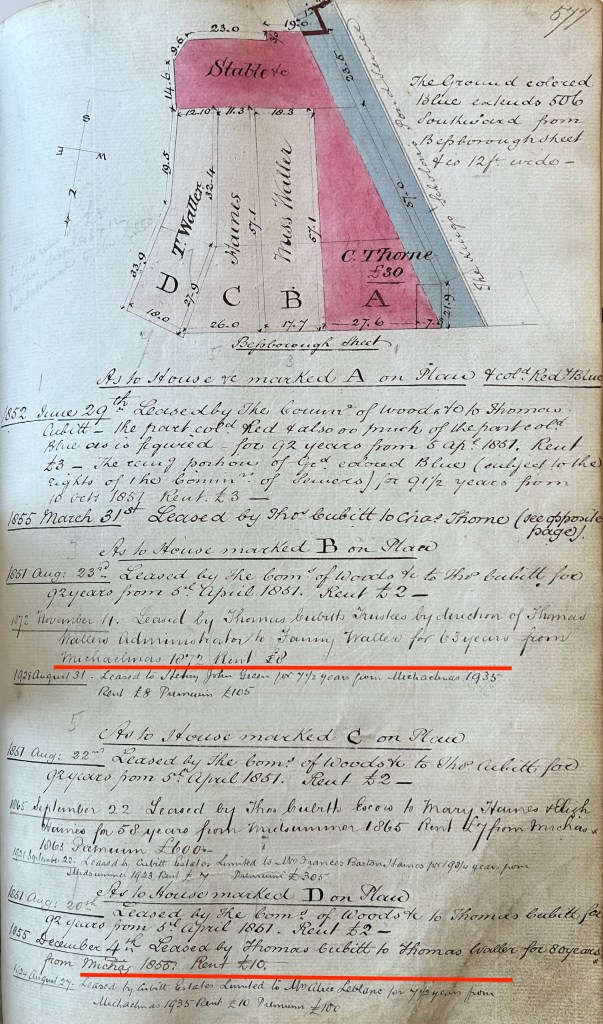
The third codicil, dated 2 December 1855, directs the executors to grant Thomas Waller a long lease on soft terms: “I intend to grant a lease to Mr Thomas Waller (who has been a confidential clerk in my office for many years) … for the term of eighty years at the yearly rent of ten pounds as a token of my appreciation of his faithful service”. The lease was of the house he occupied in Bessborough Street, Pimlico (D on the plan below). The 1856 Post Office Directory lists him at 7 Bessborough Street.
A second house in Bessborough Street (B on the plan) was leased in 1872 to Fanny Waller, his daughter, “on the instructions of Thomas Waller’s Administrator”.
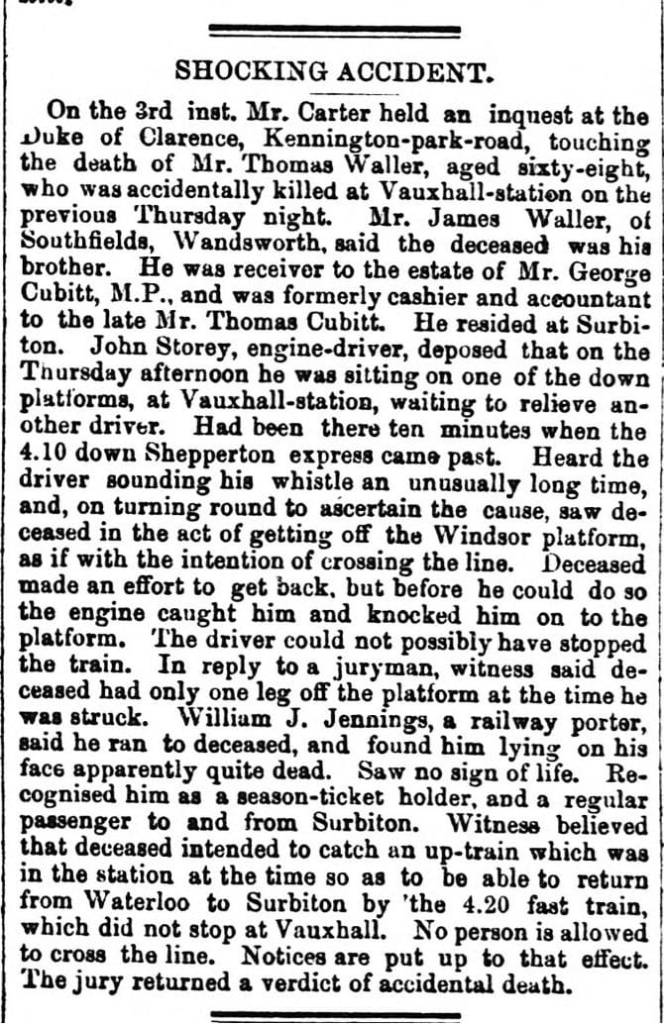
Thomas Windus Waller was killed by a train at Vauxhall station in October 1870. Press reports gave his age as 68 and his residence as Surbiton. He was then receiver to the estate of George Cubitt MP (later the first Baron Ashcombe), and had formerly been cashier and accountant to Thomas Cubitt. His brother James identified him. He died intestate, and letters of administration were granted to his widow. In 1871 Sarah Maria Waller was living in Fulham with their daughter Fanny and their son Henry, a clerk in the General Post Office Bank.
Thomas Waller’s brothers
Thomas was not the only member of his family in Cubitt’s world. His father William Waller lived at Hyde Place, Hoxton, and he and Harriet had at least seven children. Three of their sons besides Thomas can be traced.
- William was a clerk at the bank of Smith, Payne & Smiths in Lombard Street from 1820 to 1831, and witnessed Thomas’s marriage.
- James (1817–1885), baptised at Hackney, was an accountant in 1861, a builder in 1871 and a builder’s manager in 1881. He lived at West Hill Road, Wandsworth, and died there in September 1885.
- Edward (1819–1895), baptised at St Leonard, Shoreditch, was a speculative builder in Pimlico. The Cubitt Estates lease book records him taking plots in Warwick Square in 1847, and in 1857 Cubitt’s executors granted him leases of houses in Warwick Street and Cambridge Street. By 1881 he was a retired builder living in Streatham. He died at Balham in 1895, leaving nearly £19,000. His son Robert, a mantle manufacturer, was one of his executors. Between 1897 and 1899 Robert Waller and Walter Porter, as trustees of Edward Waller deceased, sold his Pimlico houses.
Robert & John Waller
John Waller and his son Robert John came from a different branch from Thomas, as far as is known. John was baptised at All Saints, Huntingdon, in 1789, and married Martha Green at St Martin-in-the-Fields in 1810.
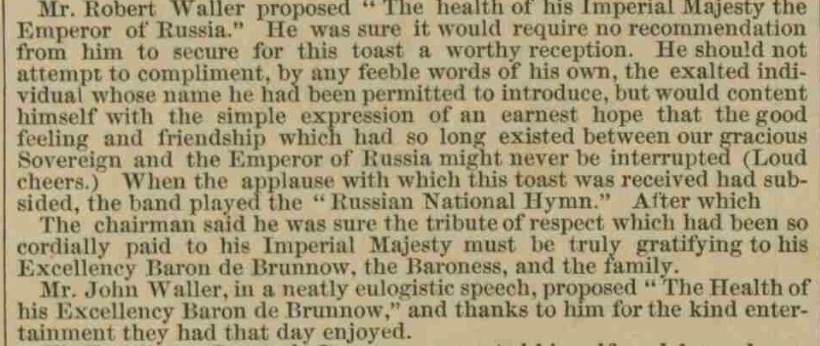
An article in the Illustrated London News of 8 January 1853 shows Robert and John Waller as leading figures in Cubitt’s organisation: both gave speeches before Prince Albert at the opening of the new residence of the Russian ambassador (full article).
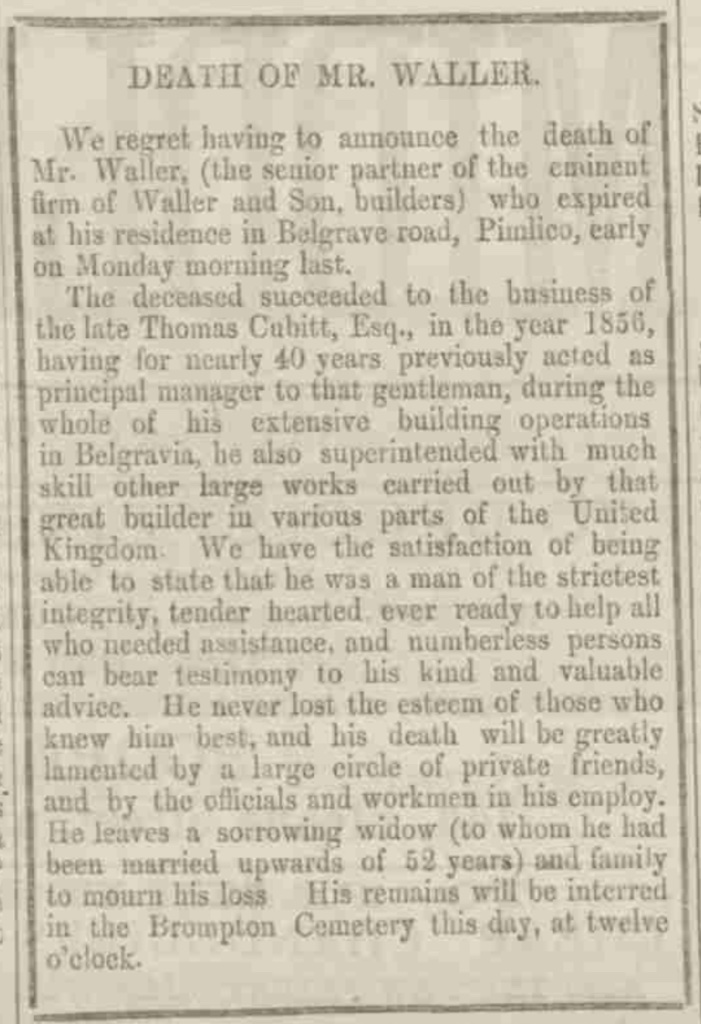
John Waller died at 5 Belgrave Road on 26 September 1864 and was buried at Brompton Cemetery. His death notice states that he “succeeded to the business of the late Thomas Cubitt, Esq., in the year 1856”. It also says he had been Cubitt’s general manager for nearly forty years. That would put the start of their working relationship at about the time of Cubitt’s work for the London Institution. The notice is John’s, not Thomas’s.
In November 1858 Cubitt’s executors leased a shop at 16 Hobart Place (formerly Grosvenor Street West) to Robert John Waller.

Robert John Waller takes on the mantle
Robert John Waller (1815–1892) was already described as a builder in the 1841 census. In March 1841 he married Harriet Shafto Pickford at St George’s, Hanover Square, daughter of Jacob Downing Pickford MD. With his father he carried the business on after 1856 as Waller & Son, from 4 Lyall Street.
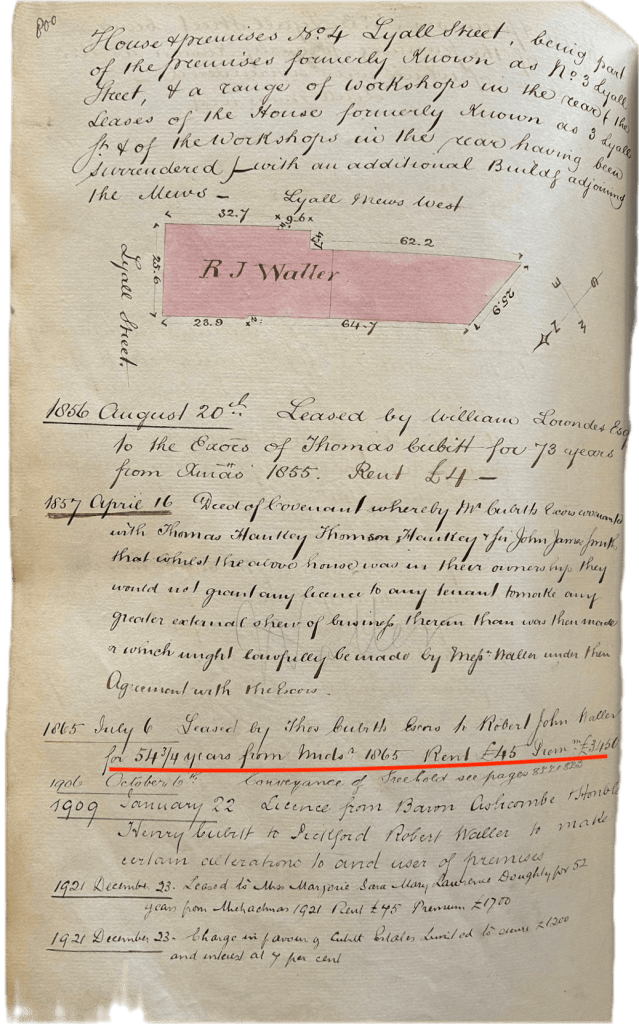
Nos 3–4 Lyall Street had been Cubitt’s offices in the final phase of the Belgravia development, a significant address to trade from. In 1856, having received an offer for No. 3, the executors divided the building in two. The lease of 4 Lyall Street to Robert John Waller, for 54¾ years, followed on 6 July 1865, and he later also took the workshops behind it in Lyall Mews. Cubitt’s trustees, and later Cubitt Estates Limited, were evidently content for the Wallers to carry on that part of Cubitt’s business.
The 1871 census shows Robert John Waller living at 4 Lyall Street, a builder employing 286 workmen, labourers, clerks and boys.

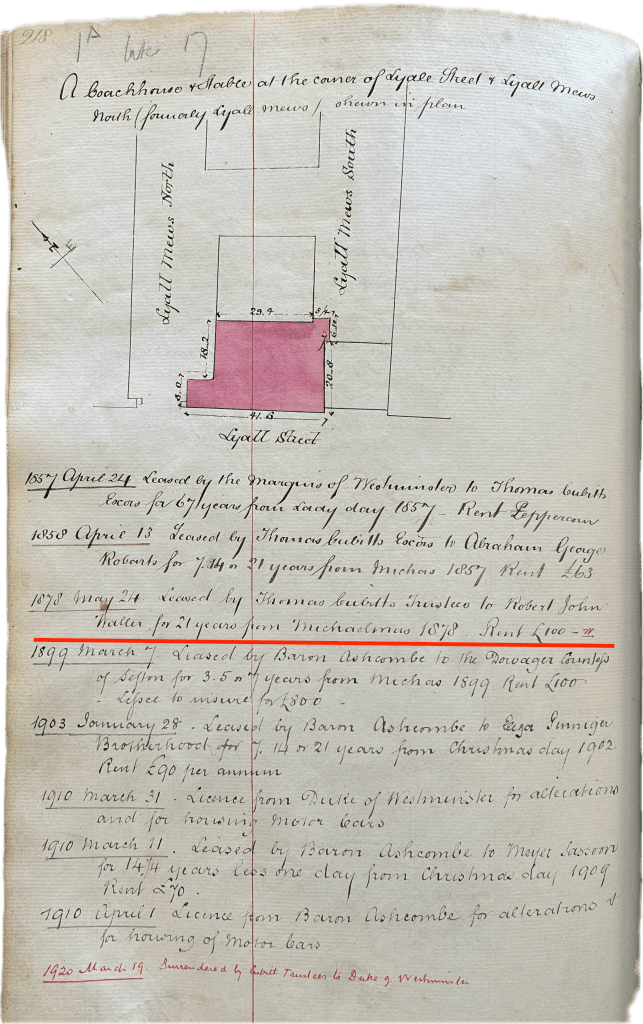
In May 1878 he took a lease of workshops in Lyall Mews.
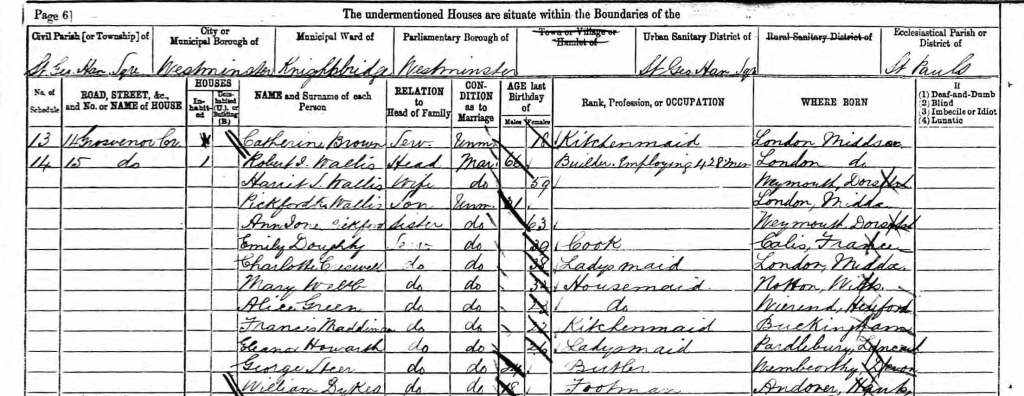
By 1881 the family had moved to 15 Grosvenor Crescent, and Robert John Waller was employing 428 men, a sizeable operation by any standard.

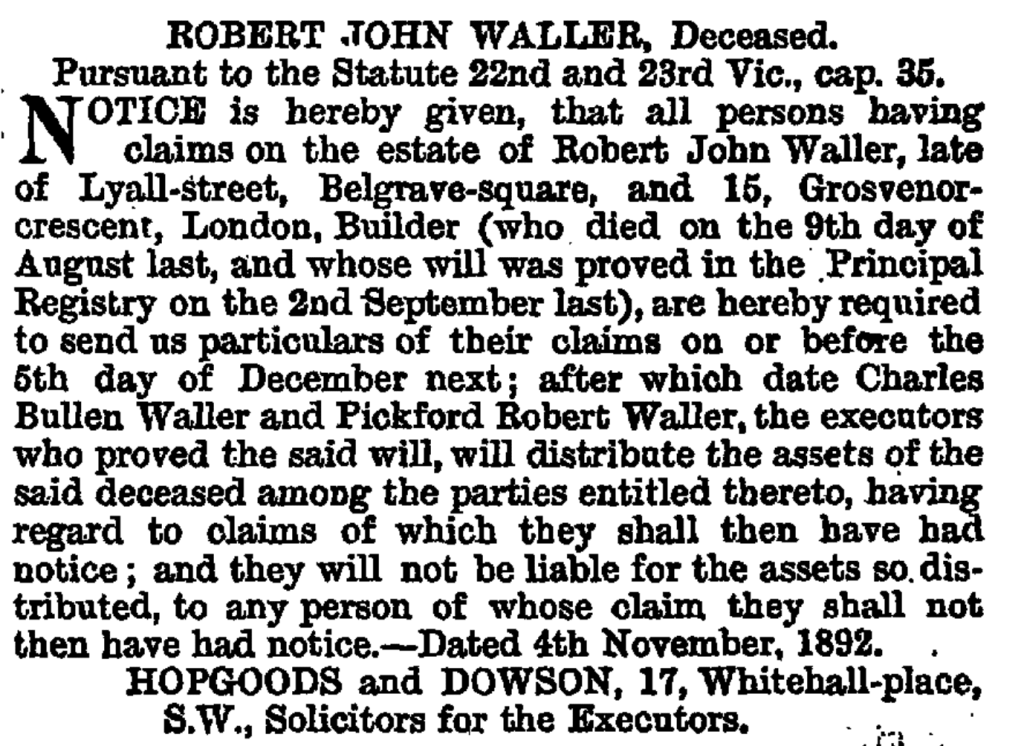
Robert John Waller died on 9 August 1892. His sons Charles Bullen Waller and Pickford Robert Waller were his executors. The notice inviting claims on his estate, published in the London Gazette on 8 November 1892, names the Hopgoods’ firm, by then styled Hopgood and Dowson, of 17 Whitehall Place.
Robert John Waller is a different man from Edward Waller’s son Robert, who acted as Edward’s executor in 1895.
Waller & Co
About 1897 the firm merged with W. G. Stevens & Co and became Waller & Co. An announcement in the Morning Post of 4 December 1897 states that Waller & Co was carrying on business as successor to Thomas Cubitt, builders and estate agents, from Cubitt’s former premises at 4 Lyall Street, Belgrave Square.
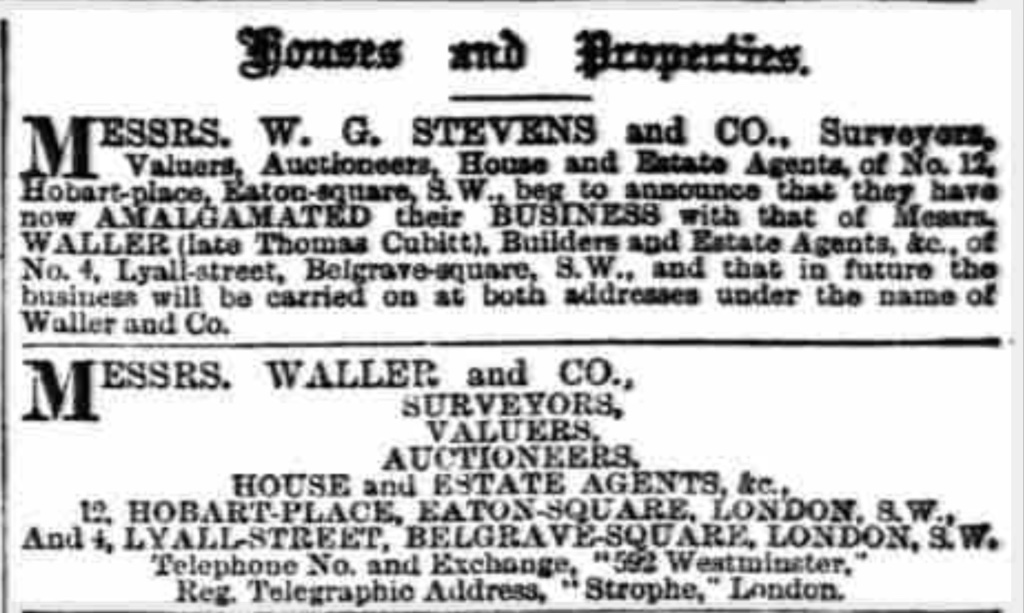
This announcement and John Waller’s death notice both state that the Wallers carried on Thomas Cubitt’s business. That suggests that the Cubitt business which later amalgamated with Holland & Hannen came from William Cubitt’s side of the family.
Pickford Robert Waller (1849–1930), Robert John’s son, entered the firm in 1867 but took little interest in it. He was a designer, bookplate artist and collector, and a friend of James Abbott McNeill Whistler (1834–1903); Whistler’s Scherzo in Blue: The Blue Girl is a portrait of his niece Maud. He also collaborated with the painter Matthew White Ridley (1837–1888). By 1896 he was living at 27 St George’s Road, Pimlico, a house sold by Andrew Cuthell’s executors in 1879. In 1909 he was licensed to alter the Lyall Street premises. His daughter Sybil Christina Waller died in 1973, and the Pickford Waller collection was sold at Christie’s the following year.
The trustees of the Cubitt estate bought the freehold of 4 Lyall Street in 1906.
Descendants of any of these Wallers, and anyone holding family letters, photographs, account books or papers, are invited to get in touch through the contact page.